
Before you sign anything
Why work with us
Most homeowners hiring a contractor for an addition are doing it for the first and only time. That is an uncomfortable position to negotiate from, so this page lays out how we work and what the rules actually say. Some of it applies to us. Most of it applies to whoever you hire, including if that is not us.
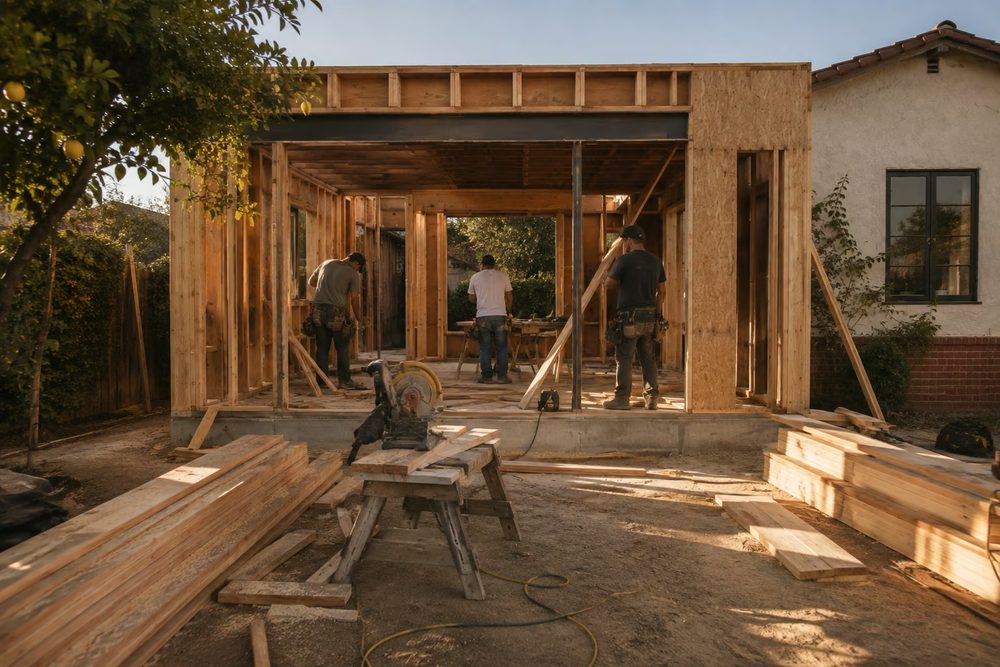
An addition is the largest single purchase most people make after the house itself, and it is bought almost entirely on trust. You cannot inspect the product first. You are paying for something that does not exist yet, on a schedule nobody can fully guarantee, based on drawings you may not be trained to read.
What follows is the part of the job we can actually put in writing before you commit.
What separates one bid from another
Six things we do differently
The estimator is on site during the build
Plenty of companies send a salesperson to your kitchen table, win the job, then hand it to a project manager who was not in that conversation. Everything you discussed that did not make it onto paper quietly disappears. The person who writes your estimate here is on the job while it runs, so what got agreed verbally still has somebody standing behind it.
We open things up before we price them
A bid written from the curb is a guess with a number attached. Before we give you a figure we want to see the attic, the crawlspace or the subfloor, the panel, and where the sewer line runs. Half of what drives the cost of an addition is invisible from the street, and the bids that ignore it are the ones that grow later.
Every permit is pulled under our license
We pull permits under CSLB #886079. If a contractor asks you to take out an owner-builder permit for work they are performing, they are moving the liability onto you, and in California they are also sidestepping the license requirement. Treat that request as the end of the conversation, whoever makes it.
You get the drawings, not just a price
Your estimate arrives with a plan set and a written scope, itemized. You can take both to another contractor for a genuine like-for-like comparison. We would rather be checked than win a job because the competing bid was hiding something.
The schedule names the parts we do not control
Plan check sits with your city, not with us. Glendale and Burbank move at different speeds, LADBS moves at another, and hillside review adds its own queue. Our schedules show those phases separately so a slow plan check does not look like a crew that stopped showing up.
Nothing gets buried without you seeing it
Before insulation and drywall close a wall, we photograph the framing, the rough electrical and the plumbing. You get those photos. Ten years from now when somebody needs to know where a line runs, the answer exists.
How a project runs
Our process, and what you hold at the end of each stage
Know this before you sign
What California already entitles you to
California writes a fair amount of homeowner protection into the contracting rules, and very little of it gets mentioned by the people it constrains. None of the following is specific to us. It applies to any licensed contractor working on your house, and it is worth knowing before you sign anything.
Check the license yourself, on the state's site
Go to cslb.ca.gov and search the license number. It will tell you whether the license is active, what classifications it holds, whether the bond is in place and whether workers' compensation coverage is on file. Ours is 886079. A number printed on a truck is not verification, and a license in someone else's name is a common problem.
The deposit is capped by law
On a home improvement contract in California, the down payment cannot exceed $1,000 or ten percent of the contract price, whichever is less. That is the statute, not a negotiating position. A contractor asking for thirty percent up front to 'order materials' is asking you to break the rule that exists to protect you.
It has to be in writing before work starts
Home improvement contracts over $500 must be written, signed before work begins, and must contain the scope, the price, an approximate start and completion date, and a payment schedule tied to progress rather than to the calendar. Verbal change orders are where disputes come from.
You have three business days to cancel
For most home improvement contracts signed at your home you get three business days to cancel in writing, with no penalty and no reason required. Anyone pressuring you to sign tonight because the price expires at midnight is working against a protection you already have.
Ask for the workers' comp certificate
If a worker is injured on your property and the contractor carries no workers' compensation cover, you can end up carrying that. Ask for the certificate and check the license record confirms it. This is the single most expensive corner a homeowner can let somebody cut.
Get lien releases as you pay
Subcontractors and suppliers can record a mechanics lien against your house if the general contractor does not pay them, even when you have paid the contractor in full. Conditional lien releases at each progress payment are the ordinary protection against it. Ask for them.
Straight answers
Questions about working with us
How do I check a contractor is really licensed?
Search the license number at cslb.ca.gov. The record shows whether the license is active, which classifications it covers, whether the contractor's bond is current and whether workers' compensation is on file. Confirm the name on the license matches the business you are contracting with, because a license borrowed from a relative or a former employer is a live problem in Los Angeles. Ours is CSLB #886079, held by Bartona Builders, which trades as Room Additions Los Angeles.
How much should I pay before work starts?
In California a home improvement down payment is capped at $1,000 or ten percent of the contract price, whichever is the smaller number. After that, payments should be tied to progress that you can see, such as foundation poured, framing complete, rough inspections passed. If a payment schedule is based on dates rather than milestones, ask why.
What happens when you find something unexpected?
We stop, photograph it, and price the fix in writing before continuing. Old Los Angeles houses regularly turn up knob-and-tube wiring, termite damage in a bearing wall, a foundation that does not match the plans, or cast iron drain lines at the end of their life. None of that is unusual. Presenting it to you as already done and already billed is what we will not do.
Who actually shows up to do the work?
Our own crew does the framing and carpentry. Licensed subcontractors handle the electrical, plumbing and HVAC, which is normal and correct, since those trades carry their own licenses. What you will not get is your job sold to whoever bid lowest that month while we take a margin for making the introduction.
Can I get a second opinion on your estimate?
Yes, and we would rather you did. You get the plan set and an itemized scope, so another contractor can bid the same work rather than a vague description of it. If a competing bid comes in much lower, compare what each one includes for structural engineering, the electrical panel and permit fees, because that is usually where the difference is hiding.
What do I have at the end besides the room?
A finalised permit, the certificate of occupancy or final inspection sign-off where one applies, manufacturer warranties on the windows, roofing and appliances, and our photographs of the framing and rough trades before they were closed up. Keep all of it. A buyer's agent will ask for the permit history, and unpermitted or undocumented work turns into a price reduction on the day you sell.
Next step
Have us come and look at it
We will walk the house with you, tell you what your city will allow, and leave you with an itemized written estimate. Nothing about that visit commits you to anything.
Read the cost guide first →
Or read about the family behind the company →
Tell us about your project
Send us the shape of it and we'll call you back, usually the same day. You will talk to someone who builds these, not a scheduler.
Ready to talk about your addition?
Tell us what you are picturing and we will tell you what it takes to build it, what your city will allow, and where the money actually goes.